


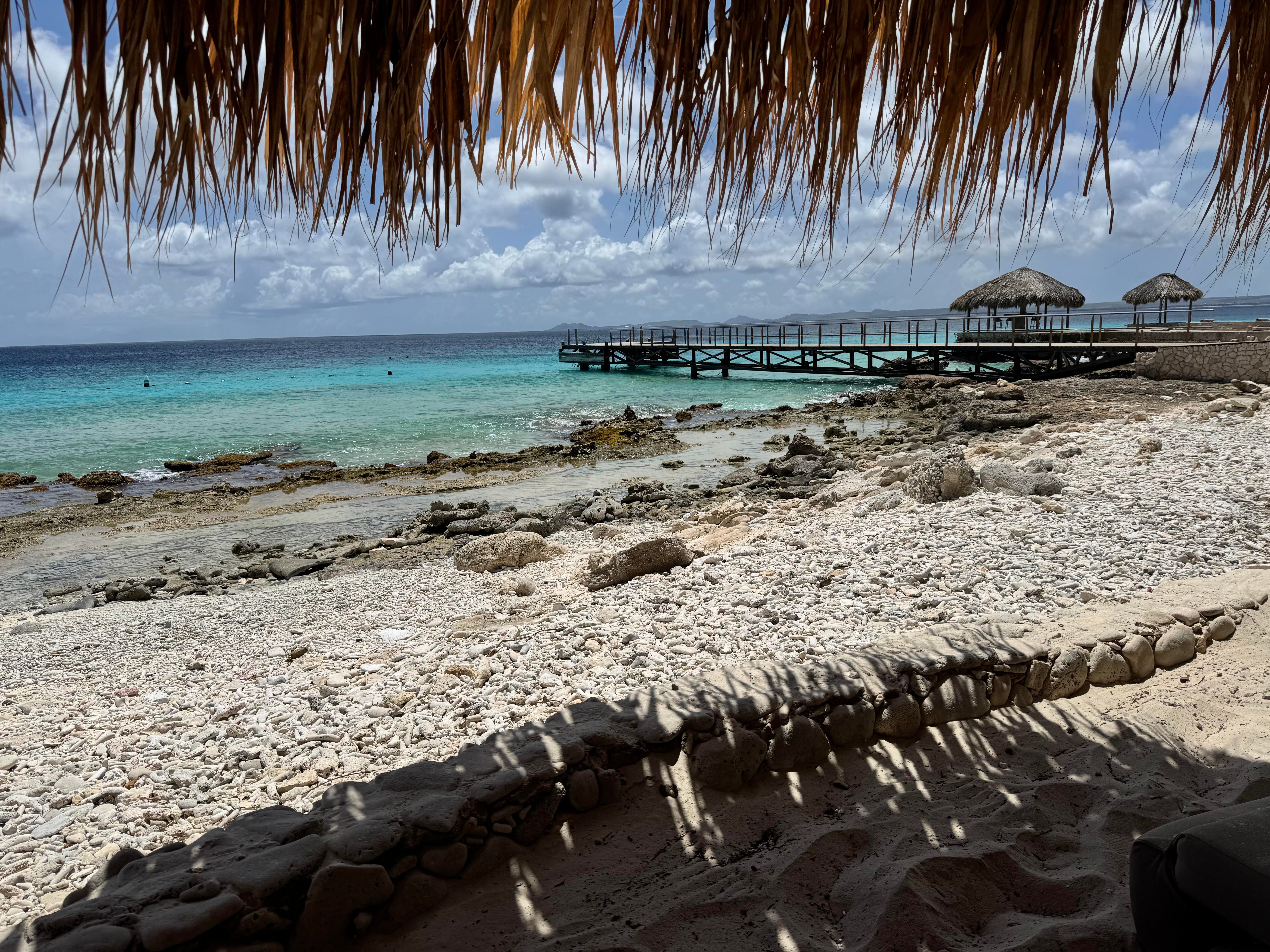
I write this sitting less than 100 meters from the inviting, turquoise waters of the Caribbean Sea. Palm trees sway as a cooling breeze sweeps through, making the tropical heat tolerable. Exotic birds sing their odes to this paradise, as iguanas perch on hot rocks to capture the midday sun.
Bonaire is a break from my regular life, an escape.
From this perspective, my world is gentle, good, and warm. But this perspective is solely my own. For Marc, the bartender who comes by periodically to check on me, this place is not his escape, but his job. This resort coddles the wealthy from foreign lands in a way that he may never be able to experience himself, only provide, invisible unless he makes a mistake. For Marc this is less paradise than a stark reminder of where he sits in the global socio-economic hierarchy.
A mere 150 miles to the southeast, the sight of an American could represent something more dire. From the perspective of the people in Caracas, Americans are enemies, oppressors, and an omnipresent threat to reduce their cities to rubble and ash.
Where we sit, when we sit there, and who we are in that seat paint our perspective. Seventeen hours ago, 1,200 miles away in Miami, Uruguay’s supporters watched a 2–2 draw against Cape Verde as a disappointment. Cape Verde’s supporters saw the same result as history.
With the mass adoption of the internet 30 years ago, and the explosion of Large Language Model AI today, we have never lived in a time like this. With new technologies disrupting the traditional access to information and communication, we are reliving the experiences of humans across millennia.
Everything is changing. There is nothing new under the sun.
Never before have people had access to so much information so quickly and from all corners of the globe. And much of that information fills us with fear and anger. Weapons of war rain down on people in eastern Europe, the Levant, and around the Persian Gulf. In our relentless, bottomless social media feeds, we see both the extravagance of obscene wealth and the depths of human-induced poverty. From this perspective, humanity seems vapid and deeply corrupt.
Things have never been worse. It is easy to move from this perspective into the pits of nihilism. Why try to be a better human today, when the world conspires to drag us all ever downward?
A fire burning bright, spewing toxic fumes, will harm those exposed to it. That conflagration captures our attention, literally blinding us to the wider world around. It leaves damage even after we have removed ourselves from its vicinity. We are evolutionarily predisposed to focus on its threat, as those who learned of the harms around them passed on their genes and those who ignored danger did not.
This is useful when the threat is immediate. It is less useful when the fire is a screen we carry in our pockets, refreshed every few seconds, teaching us that catastrophe is not an event but the permanent condition of being alive. A mind trained only to see danger will eventually mistake despair for wisdom.
Humanity is not locked in a single perspective. We possess an ability akin to magic to see beyond the horizons of time and space. Through words and images, we can convey the private interiority of our minds and experiences to the minds of those completely removed from our own location.
I sit today on a tropical beach, on a vacation provided by my father-in-law, a part of a family that treats me with deep love, care, and respect. This family would have been strangers to me just a decade ago; this island inaccessible through my own means. I was in the depths of profound loneliness following my divorce and edging towards bankruptcy from the same cause. The world around me was no less chaotic than today. The bright toxic fires burned all around and were all I could see.
We can look backward and see smallpox eradicated, rights under the law expanded, the contents of libraries made available to all at the click of a button, child labor once treated as normal made shameful by later generations. None of that progress was inevitable. None of it erased the suffering that came before. But it happened because people who lived inside their own terrifying present still chose to act as if tomorrow might be made better.
I’ve learned that perspectives can change, even if you remain in the same place. I had lost a lot, but that loss did not preclude me from finding happiness in what remained, or what I could still attain. The world was on the edge of catastrophe through forces so much greater than I could ever influence, but I did not need to change the world. I can exercise agency over the one thing I control.
Me.
The perspectives and experiences that were not my own would not come if I sat and waited for them. I needed to choose to find them. The person I was ten years ago, the person I am today, and the person you are as you read these words are not fixed things. They are all building the never-complete construction of the self.
Despair can cause us to abdicate our agency and allow the forces around us to determine who the self becomes, often to the detriment of the individual and their community. But recognizing the good, choosing to see good and build good, is not denial. It is orientation. It is how we keep ourselves from becoming servants of the worst thing we can see.
The perspective we cultivate affects whether we become paralyzed by despair or moved toward constructive change. The world may not become better because I do. But it has no chance of becoming better if none of us try.
We can understand where we sit. We can choose, imperfectly, to see through views that are not our own, while remembering that merely looking does not change their reality. Marc remains exploited. I remain a person born on global third base.
We can look for the good without lying about the bad. We can choose to build rather than merely burn.
Look at the whole field. The fire is real. But so is everything beyond the fire. We can always be better tomorrow.
If you’re ready to explore practical philosophy for everyday ethical decisions, without the academic jargon, subscribe to Radical Kindness: Empathy as Rebellion. Every week, I share frameworks for navigating moral complexity, personal stories of growth through adversity, and tools for building a more ethical life.
Join a growing number of thoughtful readers who are figuring out how to be good humans in a complicated world.