



The Trolley Problem
It’s probably the most famous thought experiment in moral philosophy. So famous that I’ll simply link to its Wikipedia page for the explanation.
Or direct you to go stream Season 2, Episode 6 of The Good Place, which is, you guessed it, The Trolley Problem.
While the Trolley Problem is a good entry point for evaluating the complexity of moral choices, it is hypothetical in a way that life rarely is. It has clear consequences on both sides of the choice.
Action will create X outcome. Inaction will allow Y result. Whether a person decides to hypothetically pull that hypothetical lever or not, they know the exact hypothetical outcomes.
We don’t get into challenging philosophical territory deciding whether or not to hypothetically kill hypothetical people. The challenging moral choices are found navigating systems where all outcomes can’t be known, where the evil is part of the foundation, and we create harms simply by operating within them.
Let’s ease into this understanding of flawed moral choices by leaving the realm of thought experiment, but staying within the world of fiction.
No Good Choices
The following will have spoilers for the film and book Project Hail Mary. I’ll be referencing the film version below, but the scenario described was translated intact from the book.
In Project Hail Mary, impossibly handsome and winsome star Ryan Gosling plays Dr Ryland Grace, a molecular biologist who looks like Ryan Gosling with messy hair and glasses. The earth is slowly getting less energy from the sun because of an extraterrestrial microorganism called astrophage, and he is the lead scientist in studying bacteria and looking for a solution.
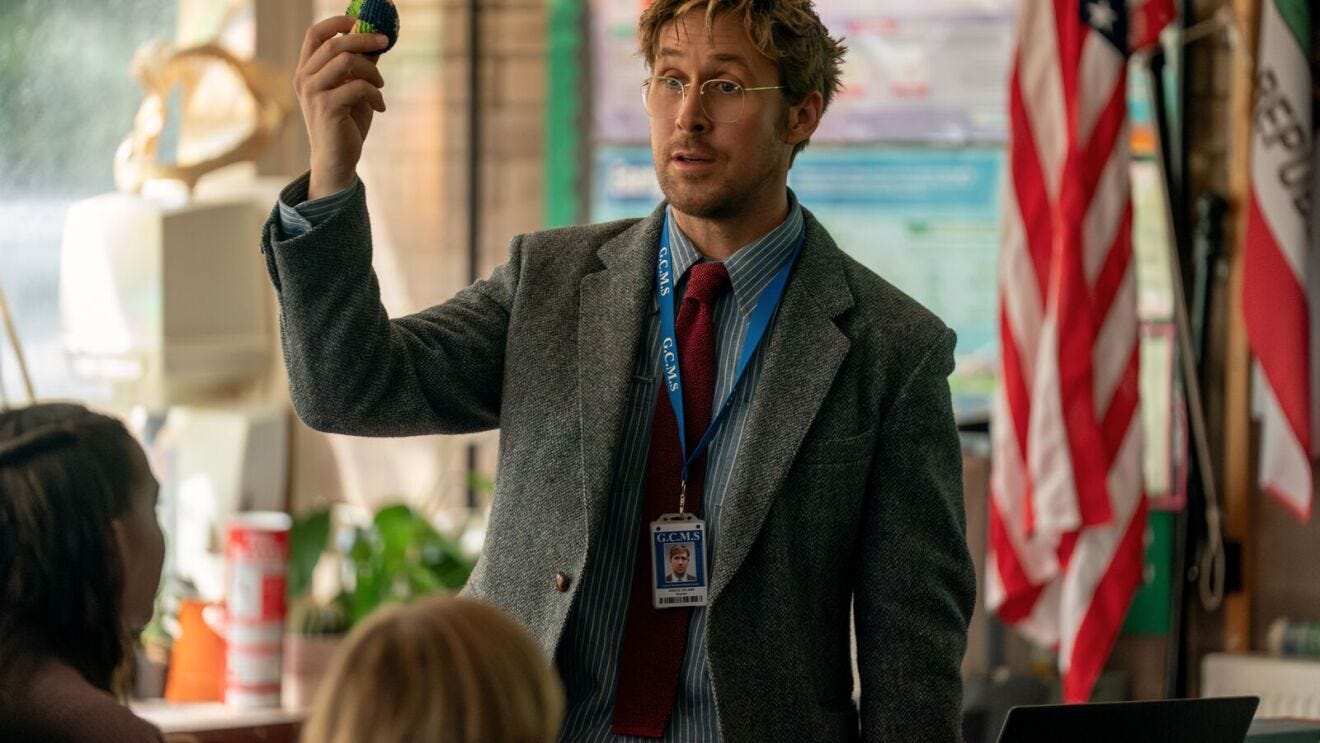
(Many plot descriptions say, “the sun is dying”. This isn’t true, the sun is fine. The astrophage are eating the sun light before it can get to earth. That is the actual problem, and I’m pedantic enough to waste an entire paragraph calling out the distinction.)
For reasons, the only potential solution is sending a mission to another star 11 light years away. The clock is ticking, every day the earth gets a little less energy from the sun, and eventually the planet will freeze, and everything will die. And before that humanity will destroy itself fighting over ever dwindling food as crops fail.
The team arrives, finds what they need, sends that back in smaller and faster ships. This is a one-way trip; there isn’t enough time or resources to prepare them to get there and back.
Make no mistake, a lot of people will die. Even if the mission is a success, it will take over twenty years to get the results, and those only help if the findings are something people have the capacity to implement. During the intervening decades the planet’s ability to support over eight billion people will falter and society will break down. And every delay in the mission increases the number of people who will die and the chance of total extinction.
Those are the stakes. As the story progresses the scientist for the mission, and their back up, are lost. Training new ones will take weeks, if not months, and missing the fast-approaching launch window will also cost the project months of time.
Time that will directly lead to millions, if not billions, of deaths.
Grace is the only replacement available; he’s worked on the science since the beginning, and they can send him with two other astronauts who can provide on the job astronaut training; they can’t train another astronaut to do the science in the same way.
And knowing all of that, Grace refuses to go. He’s pretty, but he ain’t perfect. It doesn’t matter, as he never had a choice. With the stakes being so high, he’s drugged and sent against his will. He is screaming as he is injected with a sedative, and wakes up to find himself alone eleven light years from home (the other two astronauts died en route).
Was that the right decision, to force Grace into a suicide mission? Send one man unwillingly to his death to save millions of people?
Isn’t this just Trolley Problem: The Movie?
Well, no, it’s not. For one thing, there is not one decision to be made, there are two. And the stakes are not as clear as they first appear. Let’s look at it through the lens of Ledger Ethics.
Let’s start with the stakes. Even if the mission goes off without a hitch, that does not guarantee the saving of lives.
They may arrive at the destination and not find anything that can help the earth, or what they do find is beyond what humans can do to save themselves.
They may find a solution, one that can be implemented, but send it back to a world that has long since descended into war and destruction, killing everyone before the answer could be received.
And there are two decisions. The first is for Grace. Will he pull the lever, run himself over with the trolley so that it might save the people on the other track? It’s a little different when you are filling both those roles. When he, not unreasonably, says “no”, he then triggers the decision for the project lead.
Will she pull the lever, sending Grace to his death to maybe save the people on the other track?
Wait, hang on, go back. His “no” is reasonable? Who wouldn’t sacrifice themselves to save all of humanity?
Let’s look at it from his perspective. As he says repeatedly, he is not an astronaut. This is no small point. Space travel is difficult and dangerous. Maybe he’s done the calculation in head, and his lack of training reduces the mission’s chances of success so much that the time to train a proper replacement astronaut in the science justifies the delay. After all, if he gets himself killed the mission fails.
Not to mention the death that forces on him. At best, he dies in the cold remoteness of another star. But when things go wrong in space, they go really wrong. He’s risking suffocation, decompression, starvation, conflagration. None of those are noted to be pleasant.
That said, can his logic be trusted? No matter how cold he may think his calculus is, it doesn’t change the fact that at a gut level, Grace doesn’t want to die. Or at least he doesn’t want to go willingly to his certain death. That is an emotional thumb on the scale whether he acknowledges it or not.
What does Ledger Ethics say he should do? Going back to first principles, Ledger Ethics posits that if you can help someone and do not that is an evil of indifference, whether that choice is active or not. Grace can help millions of people. He chooses not to. He is making an evil choice.
“Okay, I read your other essays,” someone might say, “and ignoring a homeless person you walk by on the street is vastly different from choosing to go on a suicide mission.”
To that I’d agree. Cost matters. And Grace isn’t being asked to pay the cost of merely acknowledging another human or putting money in their hand or voting for better housing policy. He’s being asked to die in service to humanity. The cost to him is everything.
But deciding that cost is too high has consequences. Millions die who otherwise may not have. Causing that harm is an evil, no matter how you square it.
Does Grace making an evil choice mean that the decision to force him on the mission is justifiable? After all, those making the choice are doing so to save lives. Actively helping preserve life is definitely good.
But harm isn’t limited to life and death. Grace is still a person. He has a right to have his personal dignity and autonomy respected. And by sending him on this mission, there is no illusion about the outcome for him. He will die in space, successful or not. Forcing someone to their death, no matter the justification, is also an act of evil.
Neither Grace nor those who force him on the mission are responsible for the situation they find themselves in. They didn’t create the scenario. They are still forced into choices that invariably lead to evil outcomes.
The success of the mission (it’s a $248 million blockbuster; did you think they did that with a downer ending?) doesn’t absolve anyone of the harm they chose. The harm remains on their ledgers. It contributes to the people they are.
Making a choice to force Grace on the mission is understandable, considering the stakes. But it also makes it easier to do that should the choice arise again.
What if it’s not for the fate of all humanity?
That is fiction. What about real life?
Most moral choices happen within systems that are built by people.
Systems like nations. Systems like politics. Systems like war.
War
“War is a continuation of politics by other means” – Prussian military theorist Carl von Clausewitz.
“I said, war, huh (good God, y’all). What is it good for? Absolutely nothing.” – the guy who sings that song War.
From the first act of violence, war is a choice. A choice that will send people to their deaths. That will destroy and make the material reality of people worse, leading to more suffering and harm.
As the conflict escalates, it forces more choices on people, and the evil of the situation colonizes the available choices.
Even the so called “Good War”, WWII, caused harm for every person involved. The narrative we like, that imperial aggression of the Axis powers, the industrial scale genocide of the Holocaust, these were things that justified the violence used to stop them.
The harms caused by the Nazis, Imperial Japan, and their allies were evil, and they needed to be stopped. But that didn’t change the fact that farm boys from Iowa, housewives from Marseille, and factory workers from Nizhny Novgorod were forced to kill, deceive, and deny the humanity of their foes.
A generation of humanity with permanent evil in their ledgers. A necessary evil perhaps; there was no path to stop what the Axis were doing without harm. But it was evil none the less.
Ledger Ethics tells us these harms committed, even to stop greater evil, are not redeemed by stopping that evil. Architectural Humanism tells us that the harm in the ledger shape the people we are. Evil may have been stopped, but the war wasn’t won.
Winning a war implies a net positive was gained. But nothing is gained in war. At best worse harm is stopped. And in the process people kill, thus lowering the bar to kill in the future. People destroy, lowering the friction for future destruction. Damaged people come home and raise children, build institutions and do so with the influence of the trauma they bring home.
But the people who fought WWII are now nearly all gone. What about the conflicts of today? As I write this millions of people around the Persian Gulf watch the skies in fear of sudden incoming death. Americans, Iranians, Israelis, Saudis, Qataris, and more being forced to endure and commit violence.
Evil is everywhere. Evil that was chosen.
I’m not here to argue that Iranian government was innocent. They deny the right of their people to choose their faith and live in accordance with their own beliefs. They enforce this denial with state sanctioned violence. They fund violence across the region.
But none of that represents the same existential threat that inflamed the world in the 1930’s and 40’s. There were diplomatic options available. This is a war of choice. It is the continuation of politics by other means.
It is a choice to kill. It is a choice to make people kill. For those who survive, they will need to make a life in a harder world, a world with greater scarcity and cruelty.
The people making those choices, the ones launching strikes, the ones funding proxies, the ones who looked at a diplomatic solution coming within reach and decided that was the wrong outcome, they are writing permanent entries in their ledgers.
And in the people they are building.
And in the world those people will build after them.
That is Architectural Humanism’s most sobering verdict. The harm doesn’t stay contained to the moment of the choice. It distributes forward. Into the soldiers who come home harder. Into the children raised by harder people. Into the institutions built by people who have normalized what they had to do to survive. The evil propagates, and it does so through the very people who were damaged by it.
This is why “winning” is the wrong frame for any of it.
Nobody won World War II. They survived it. The distinction matters because winning licenses celebration and closure. Surviving demands reckoning. And most of the suffering that followed, the Cold War, a traumatized generation, was the reckoning that never fully happened, showing up anyway in the architecture of the post war world.
Nobody will win whatever emerges from the Persian Gulf. They will survive it, or they won’t, and either way the ledgers of the people involved will carry what was done there permanently. The Iranian regime’s genuine evil does not absorb those entries. The strategic justifications do not erase them. The outcome, whatever it is, will not travel backward in time and redeem the choices that were made.
Ledger Ethics asks one thing of us that most moral frameworks work very hard to avoid: carry the full weight of what was done, by whom, to whom, regardless of what came after.
That’s a harder way to live than a philosophy that lets outcomes settle the books. It means Grace and the people who forced him across the stars are all marked, even though the mission succeeded. It means the soldiers who stopped the Holocaust carry something permanent, even though stopping the Holocaust was necessary and right. It means the people ordering strikes on Tehran are writing on their ledgers in ink that doesn’t fade, regardless of what they believe they’re preventing.
A moral framework that promises clean hands is selling something.
The trolley problem gives you a lever and clear tracks and the luxury of knowing exactly what each choice costs. Real moral life gives you a field of options that someone else’s choices already contaminated, imperfect information, fear that calls itself calculation, and a ledger that keeps running long after the moment of decision passes.
Nobody wins. The ledger just records what happened.
That’s not pessimism. It’s the most honest accounting available.
If you’re ready to explore practical philosophy for everyday ethical decisions, without the academic jargon, subscribe to Radical Kindness: Empathy as Rebellion. Every week, I share frameworks for navigating moral complexity, personal stories of growth through adversity, and tools for building a more ethical life.
Join a growing number of thoughtful readers who are figuring out how to be good humans in a complicated world.
Another exceptional piece once again Anthony! I truly admire the way in which you are able to view everything through the lens of morality :) I wonder though what you think! If no moral framework can promise clean hands, then what distinguishes a better choice from a worse one? The amount of suffering? Would you identifiy yourself as an utilitarian? Anyway, interested to hear more of your thoughts!! Also, you've made me look at this movie from a different perspective, which is funny because as we've talked about, I was quite resigned to dislike it!